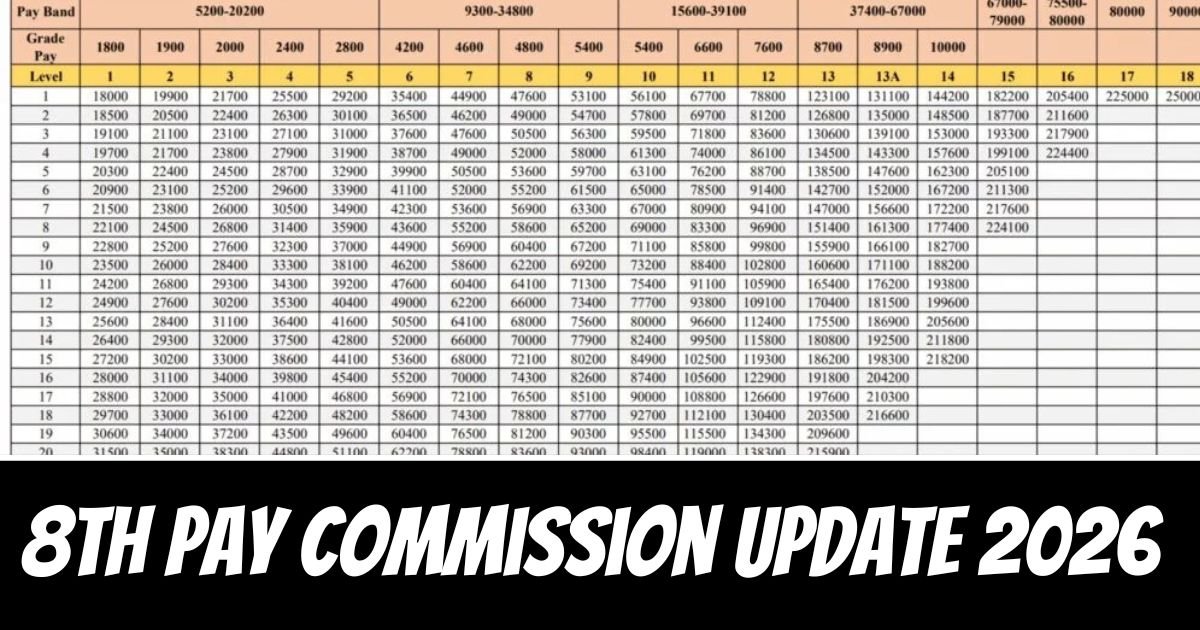
Just picture millions of central government employees who will receive their checks all swelled up for higher amounts in 2026. The suggestion of the 8th Pay Commission promises substantial revisions in the pay package, pension, and allowance sections to spur optimism, thus opening the door to this epoch-making change.
Establishment And Sanction
The 8th Central Pay Commission was constituted by the Government of India in January 2025 with Prime Minister Narendra Modi’s assembly chairing the process. This was followed by the approval of the Terms of Reference (ToR) by the Union Cabinet later on. This is a pivotal moment when the Commission is actually set up.
The Commission is an ad hoc body, comprising a Chairperson, one part-time Member, and a Member-Secretary. The body has eighteen months to tender its recommendations.
Expected Timetable For Implementation
Pay panel recommendations usually take ten years to bear fruit. The Seventh CPC began in January 2016 and will cease by December 31, 2025. The eighth aims at implementation from January 1, 2026.

The exact date is decided by the government. The Employees Unions are, nevertheless, hoping for a retrospective effect from January 2026, inclusive of arrears. A few answers and parliamentary issues signify that the decision will follow shortly.
Who Benefits From The Reforms
I believe that amendments would affect 50 lakh-plus central government employees, and then an additional 69 lakh pensioners will get the enhancement in their pensions. This commission is applicable to civilians, defense personnel, as well as their dependents.
State governments, not far behind, often go along for similar changes. This so-called government-to-government interaction transfers the effect further down the line right through the body of public sector employees’ giant family.”
Key Expectations Salary And Fitment Factor
Concerning the restitutions, specialists predict deciding to integrate present dearness allowance into basic pay. DA literally hit around 58% as at end-2025. Such unification will bring the DA to zero and boost the acceptance of the basic salary.

Like a coefficient of the multiplied thereof to-the-corresponding basic pay according to the new Pay Matrix. Opinions are varied, ranging from 1.83-2.86, while the general projection is around 2.46.
| Current Minimum Basic Pay (7th CPC) | Expected Fitment Factor | Projected New Minimum Basic Pay | Approximate Hike Percentage |
|---|---|---|---|
| ₹18,000 | 2.00 | ₹36,000 | 100% (with DA merger) |
| ₹18,000 | 2.46 | ₹44,280 | ~146% (with DA merger) |
| ₹18,000 | 2.86 | ₹51,480 | ~186% (with DA merger) |
Impact On pensions And Other allowances
The pensioners are expecting parity. By default, a minimum pension could be larger. Salaries are all under the purview of sacred cows. Allowances like HRA and Transport Allowance are being updated. Some operational incentives might witness an overhaul in some shape or form while performance benefits are the actual thing.
